
Kimchi
There are over 200 different recognised types of kimchi in Korea but the most iconic is the spicy, red baechu kimchi, made with napa cabbage.
Here’s my recipe. For more, sign up to my weekly newsletter.
These quantities make roughly a 1l jar depending on the size of your cabbage but feel free to scale up or down.
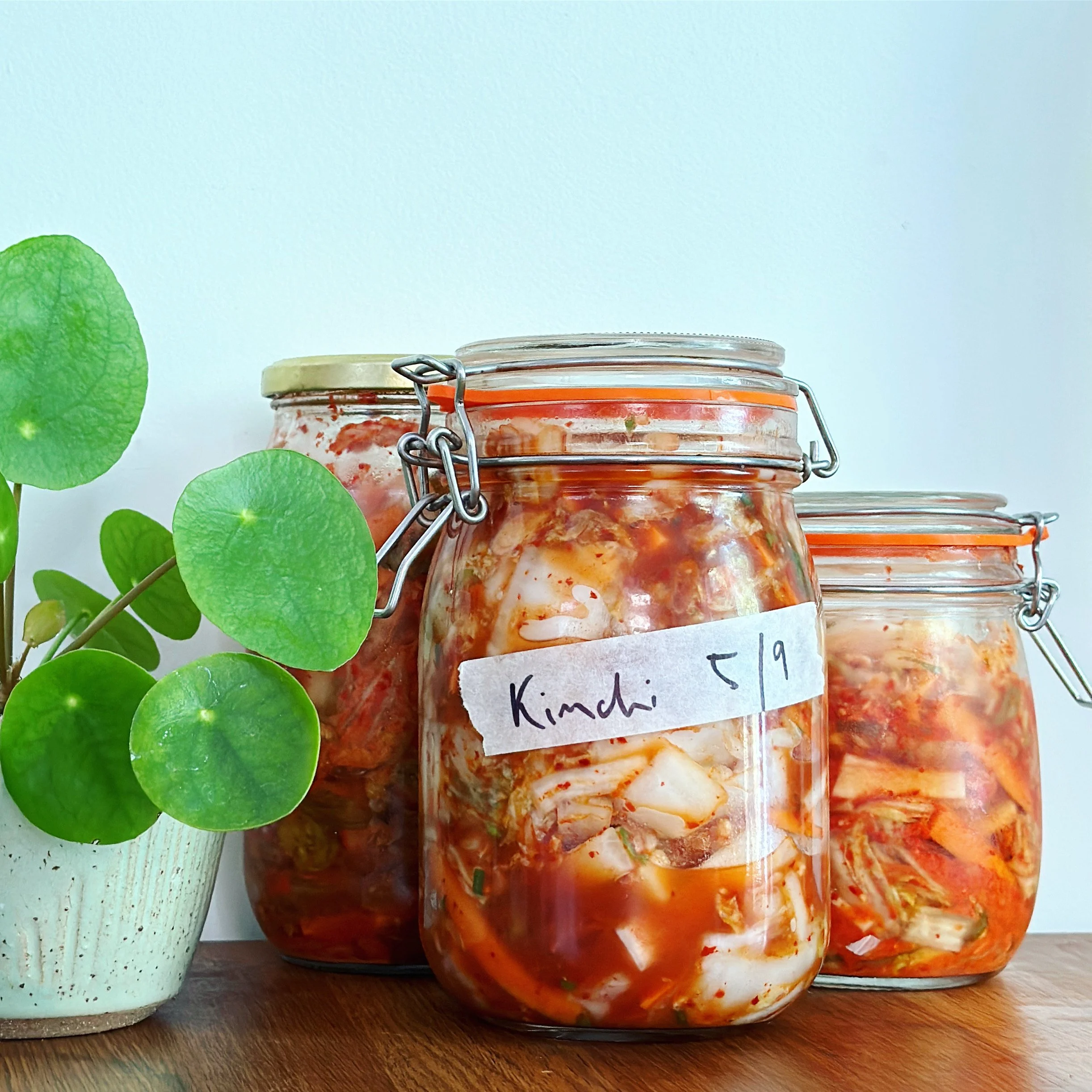
Ingredients
1 head Chinese/Napa cabbage
40g flaky sea salt
100g mooli (approx 1/3)
1 carrot
10g glutinous rice flour (optional - see note)
1⁄2 inch ginger
6 cloves garlic
1 tsp sugar
2 tbsp gochugaru Korean chilli flakes (or to taste)
3 tbsp fish sauce (for a veggie option replace with 2 tbsp soy sauce and 1 tbsp miso)
4 spring onions
Method
Slice the cabbage in half through the root and firm white part, stopping about halfway up where the leaves begin to get frilly. Get your thumbs into the opening and pull the cabbage in half. Doing it this way keeps the frilly inner leaves more intact than slicing through the whole thing. Also, I find it is deeply satisfying in an ASMR kind of way. Use the same method to divide the halves lengthways again into quarters.
Slice the cabbage quarters into bitesize pieces. I like them quite chunky, maybe an inch and a half. Smaller, more shredded pieces will make a more homogenously textured kimchi. It’s completely up to you. If you don’t have a pickle weight, remember to save the quartered root.
Put the pieces of cabbage in a bowl, toss with the salt and a small splash of water (just a couple of tablespoons) and set aside for 90 minutes – 2 hours.
Peel and cut the mooli and carrot into batons. Again, I like them quite chunky to provide crunch. More matchsticky bits will make a more evenly textured kimchi. You do you. Add them to the cabbage and mmix through. Occasionally
come back and toss the vegetables again to make sure everything gets equal exposure to the brine which is produced.
Meanwhile put the glutinous rice flour in a pan and add 80ml cold water. Whisk to combine then bring to a boil over a medium heat. It will thicken and look like wallpaper paste. Set aside to cool.
Peel and crush the garlic and ginger. Add it to the rice flour porridge along with the gochugaru, fish sauce (or soy and miso) and sugar. Alternatively just blend the rice flour porridge with the other ingredients in a food processor.
Finely slice the spring onions, whites and greens. Add to the paste and set aside until needed.
Once the cabbage has been brining for a couple of hours you will notice that it has wilted and shrunk. The other veg will be less visibly affected but will also have given out some water. Drain them in a colander over the sink and rinse thoroughly. Rinse the bowl too. Taste a little bit of cabbage. A hint of salt is fine but you don’t want loads. Give everything a squeeze to remove as much water as possible but don;t manhandle too mkuch or you will make the leaves floppy. Return the veg to the bowl.
Add the chilli paste to the caggage, gently massaging the leaves until it is evenly distributed (you can use gloves to go this if you like, I would recommend it). Pack into a clean jar along with any liquid remaining in the bowl. Use a pickle weight or a couple of bits of the root to keep everything under the brine and seal the jar. Place it on a plate or tray to catch any leakage and leave at room temperature, out of direct sunlight.
Check the kimchi every day, opening the jar to let the gas escape and tasting a little bit. It will be pretty active in the first couple of days so be careful when opening it. Don’t wear you best silk blouse basically. When it is as sour and funky as you like (anywhere from 2/3 days to 2/3 weeks), move it to the fridge. This won’t stop the fermentation but will slow it right down. The kimchi will keep in the fridge indefinitely.
Notes (If Ifs And Ands Were Pots And Pans…)
The rice flour porridge isn't crucial but helps the chilli paste coat the cabbage. Glutinous rice flour is not the same as the rice flour you’ll find in the baking aisle. Like gochugaru, you’ll find it in Asian supermarkets. You can use cornflour, portato starch or tapioca starch instead, all prepared in a similar way. I have not tried wheat flour but am told it does a similar job. You want to stick with roughly that 1:8 ratio. Anything that makes a nice pasty consistency so the flavours evenly coat the vegetables. Or you can leave it out and just thin your chilli , garlic, ginger mixtuyre with a little water or stock.
As kimchi develops it will get funkier then more acidic. There will also be more brine in an older jar of kimchi as water continues to be drawn from the vegetables. Generally kimchi is eaten it as a side dish when it’s fresher and cooked wth it when it’s older. I’ll be sharing a few things to do with your kimchi over the coming weeks Cabbages and Kimchi has a wonderful sppicy pork stew recipe and also introduced me to the fabulous idea of kimchi pickled eggs.